
Keep the selected source
Retain the material you actually reviewed and the passages you cited.
 Contact
RO
Pylotheke
A review is more useful when someone else can follow it. Pylotheke keeps selected sources, findings and corrections together, so the next review can start with the work—not the search for it.
Local Linux prototype · No public download
Who it is for
What you can explore
Hand over the source behind the finding
Keep corrections without losing earlier findings
Compare an update with the passages you actually cited
Follow a review
A finding is easier to revisit when its source, cited passage and corrections stay together. Explore the saved example to see the kind of record Pylotheke produces.
Retain the material you actually reviewed and the passages you cited.
Record a revised finding without losing the earlier version or its evidence.
Check what changed at the original citation locations. The reviewer decides what that means for the finding.
There is no public application download. You can inspect the saved report and ask about a review workflow; the software is in development.
No. It records selected evidence and comparison results. Interpreting those results remains the reviewer’s responsibility.
Citations are compared at their original byte positions. They are not automatically followed to a new location.
Describe the material you review, the people who need to check it and what is difficult to preserve. Start with a description, without confidential source files or credentials.
Offline source review
Pylotheke
Review a source file, record a finding, and keep the supporting evidence together. Pylotheke produces local reports you can return to when you choose to review an updated version.
In development. Not yet available for public use. The current version runs locally from the command line on Linux.
A review needs more than a conclusion. Which files did you inspect? Which passage supports the finding? What did you correct? Does an updated file still contain the same cited bytes?
Pylotheke is for technical reviewers and maintainers who need to preserve those details alongside their judgments. The current version works with public or invented files you choose, using local commands to produce reports you can read in a browser.
Choose the files you want to review. Pylotheke keeps those files with the review and records the excerpts you select as evidence. The report makes missing selected material visible.
Harbor Notes is an invented project. One referenced file is deliberately absent from the selection. Its contents remain unknown.
Record what you found alongside the supporting source. If you correct the finding later, readers can inspect both versions and the evidence behind them.
The demonstration starts with an intentionally mistaken finding, then records a correction. Both versions remain available to inspect.
Choose the updated files and match them to the earlier selection. Pylotheke creates a report showing file changes and what changed at each citation’s original location. You decide whether the finding needs to change.
Citations are checked at their original positions, not followed automatically when text moves.
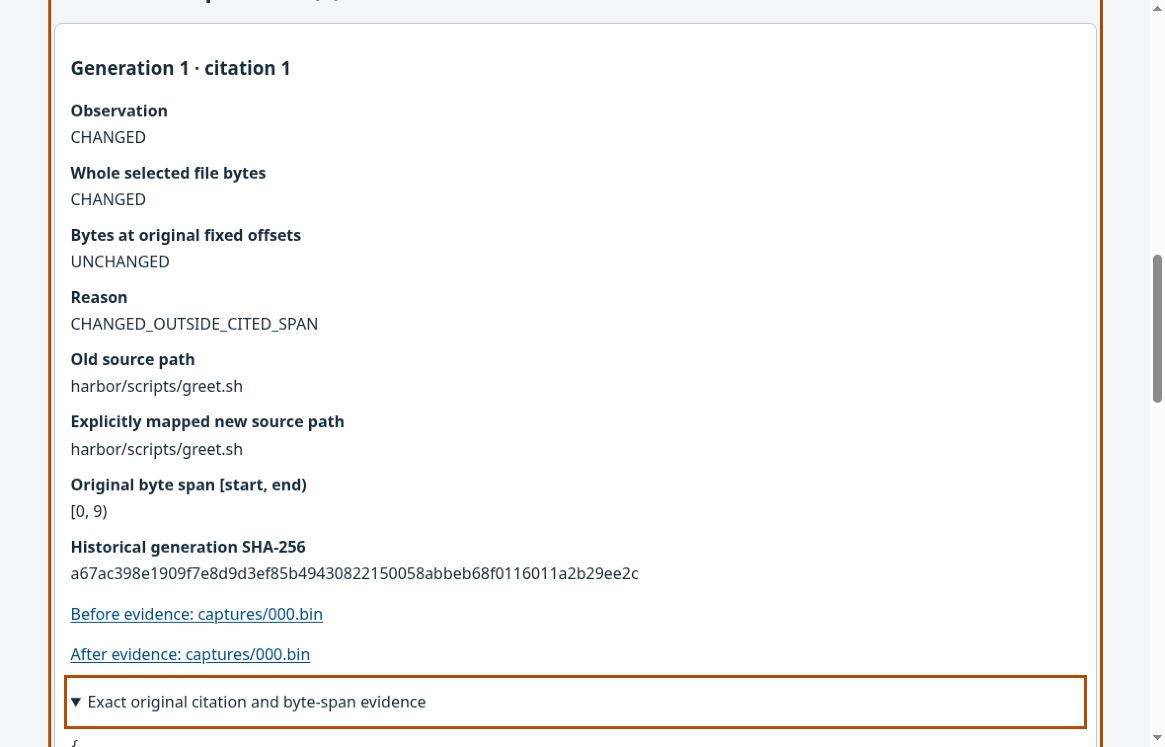
Here, a comment changes outside the cited passage. The report separates the file change from the unchanged material at the original citation location. It does not decide whether the finding is still valid.
Keep the selected source and its citations with the review, so another reviewer can inspect the same material without needing the original source folder.
A corrected finding keeps the earlier version available. Readers can follow the correction instead of seeing only the latest conclusion.
See which selected material is missing, which updated files have not been matched, and where the evidence is still unknown.
The current commands use Python’s standard library. They need no network connection, model or paid service. Generated reports open locally in a browser.
Pylotheke is in development and is not available for public use or download. The current version is a local Linux command-line workflow; distribution licensing is still unresolved.
If you want to discuss a use case, contact 47Network and mention Pylotheke. Describe the review task without sending confidential source files.
An enquiry does not reserve access or commit you to a purchase.
Pylotheke records what was selected and what the comparison found. Interpreting that evidence remains the reviewer’s responsibility.
With the documented verification tools and a separately retained hash, you can check that a copied handoff matches the reference. Hash checks establish that bytes match an independently retained reference. They do not authenticate the publisher, establish source rights, prove a claim or approve the inspected software for use. Reports retain complete selected source files, even when a visible excerpt is short.
You supply the updated selection and an explicit file-path mapping. Citations are compared at their original byte offsets. They are not automatically relocated, and findings are not automatically re-evaluated. Missing source means it is absent from the selected capture, not necessarily deleted from the original repository.
The development version described here requires Linux with separately installed Python 3.11 or later. The retained test observation is CPython 3.12.14 on Linux x86_64; this is not a tested compatibility matrix. Windows and macOS have not been verified for this version. The workflow uses local commands and read-only HTML reports rather than a browser editor.
Pylotheke is still in development. Public distribution licensing and live integrations are unresolved. Use the documented limits for selected inputs; handling very large inputs has not been fully reviewed. Opening a saved report does not check its original inputs again.